The Crumblesworth Dynasty: A Tale of Flour, Fortune, and Feline Ambition
Part I: The Rise of Sir C. C. Crumblesworth III
In the genteel borough of Catford, where the morning mist clung to Georgian townhouses like butter on warm toast, there lived an aristocat of unparalleled distinction. Sir Charles Carlsberg Crumblesworth, third of his name, was a magnificent tabby whose whiskers curved with the same precision as the crescent rolls produced in his extensive network of bakeries.
Sir Crumblesworth hadn't been born into wealth—no, his fortune was kneaded from ambition and yeast. In his youth, he'd been a common mouser at a riverside grain mill, but he possessed what other cats did not: an exquisite palate and an entrepreneurial spirit that would make any Victorian industrialist purr with envy.
His breakthrough came one fog-laden evening when he observed the mill's baker struggling with a sourdough starter. With a few decisive paw swipes and an inexplicable understanding of fermentation, young Charles corrected the mixture. The resulting bread was so sublime that orders flooded in from across London. Within a decade, he owned seventeen bread factories and a chain of artisanal bakeries stretching from Westminster to Brighton.
Sir Crumblesworth's empire was built on a simple philosophy: "We make the cookies crumble." His factories hummed day and night, producing everything from working-class loaves to brioche so delicate it practically dissolved on the tongue. His artisanal bakeries—each bearing the Crumblesworth crest of a crowned cat clutching a baguette—became gathering places for high society. Countesses would wait hours for his cranberry walnut levain.
The Queen herself (not a cat, regrettably, but one must make allowances) knighted him for "services to carbohydrates and the Empire." Sir Charles accepted with characteristic grace, though he was found later that evening napping in the Royal breadbasket.
Part II: The American Expansion and the Fall
But empires, like croissants, grow flaky with time. Sir Crumblesworth's descendants grew restless. The British market, they argued over family dinners of poached salmon and cream, was saturated. Every corner had a bakery. Every household had bread. Where was the growth? Where was the vision?
It was Sir Charles's great-grandson, Montgomery "Monty" Crumblesworth, who first suggested America. "Dear Bert," he said to his brother Camembert over afternoon tea, "across the Atlantic lies a land hungry for quality baked goods. They eat something called 'white bread' from bags. Can you imagine?"
Bert could not, in fact, imagine such horror.
Thus began the great Crumblesworth migration of 1892. Monty and a cadre of enterprising Crumblesworths sailed to New York, their steamer trunks filled with sourdough starters and family recipes written in elaborate cursive (and occasionally in claw marks when the ink ran out).
America proved even more lucrative than England—at first. The Crumblesworths opened factories in Chicago, bakeries in San Francisco, and established what would become an American institution: Crumblesworth's Continental Bakery, where one could purchase both a decent baguette and the American dream.
But the dream, like day-old bread, grew stale.
The dynasty's downfall came gradually, then suddenly. The younger Crumblesworths, born into wealth rather than having clawed their way to it, lacked Sir Charles's vision. They expanded too quickly, borrowed too heavily, and most fatally, they began cutting corners. Premium flour gave way to cheaper alternatives. Artisanal techniques were replaced by industrial shortcuts. The Crumblesworth name, once synonymous with quality, became just another brand.
The Great Depression was the first blow. Factories closed. Bakeries shuttered. The family fortune, once as solid as a well-proofed dough, deflated like a failed soufflé.
Then came the rise of supermarket chains in the 1950s and 60s, with their industrialized bread that could survive a nuclear winter (and tasted like it might have). The Crumblesworths couldn't compete. One by one, the remaining bakeries were sold off, the recipes lost or forgotten, the legacy reduced to a footnote in culinary history books that no one read.
By the 1980s, the last Crumblesworth bakery—a small shop in Vermont run by a elderly calico named Beatrice—closed its doors forever. The dynasty was done. The empire had crumbled, quite literally.
Part III: Carl—The Last of the Crumblesworths
Generations passed. The Crumblesworths scattered across America like breadcrumbs, their fortune gone, their legacy faded. Most forgot they'd ever been aristocats at all.
Which brings us to Carlsberg Chili Cheese Crumblesworth, known to everyone simply as "Carl."
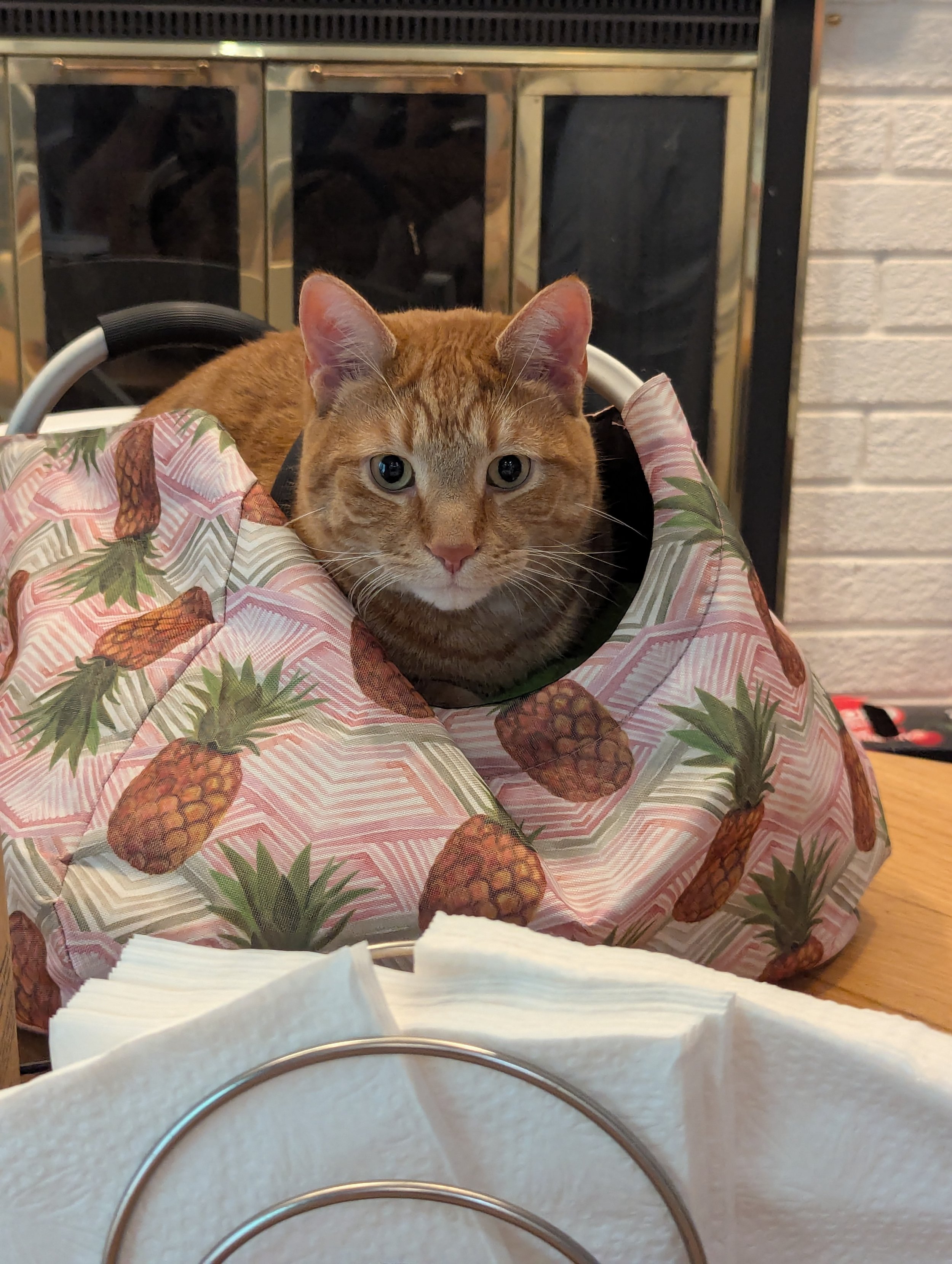
Carl lives in a comfortable suburban home in Indianapolis. He is a magnificent orange tabby with a striking figure if you ask his friends. If you showed him a pictures of Sir Charles Carlsberg Crumblesworth, he might see a family resemblance in the confident way they both hold their whiskers. Or he might try to knock it off the mantle. It's hard to say.
There is no family fortune. Carl's humans work regular jobs, and Carl himself works not at all, unless you count his rigorous schedule of napping , grooming, and what he calls "quality control".
His passions in life have evolved beyond the family business:
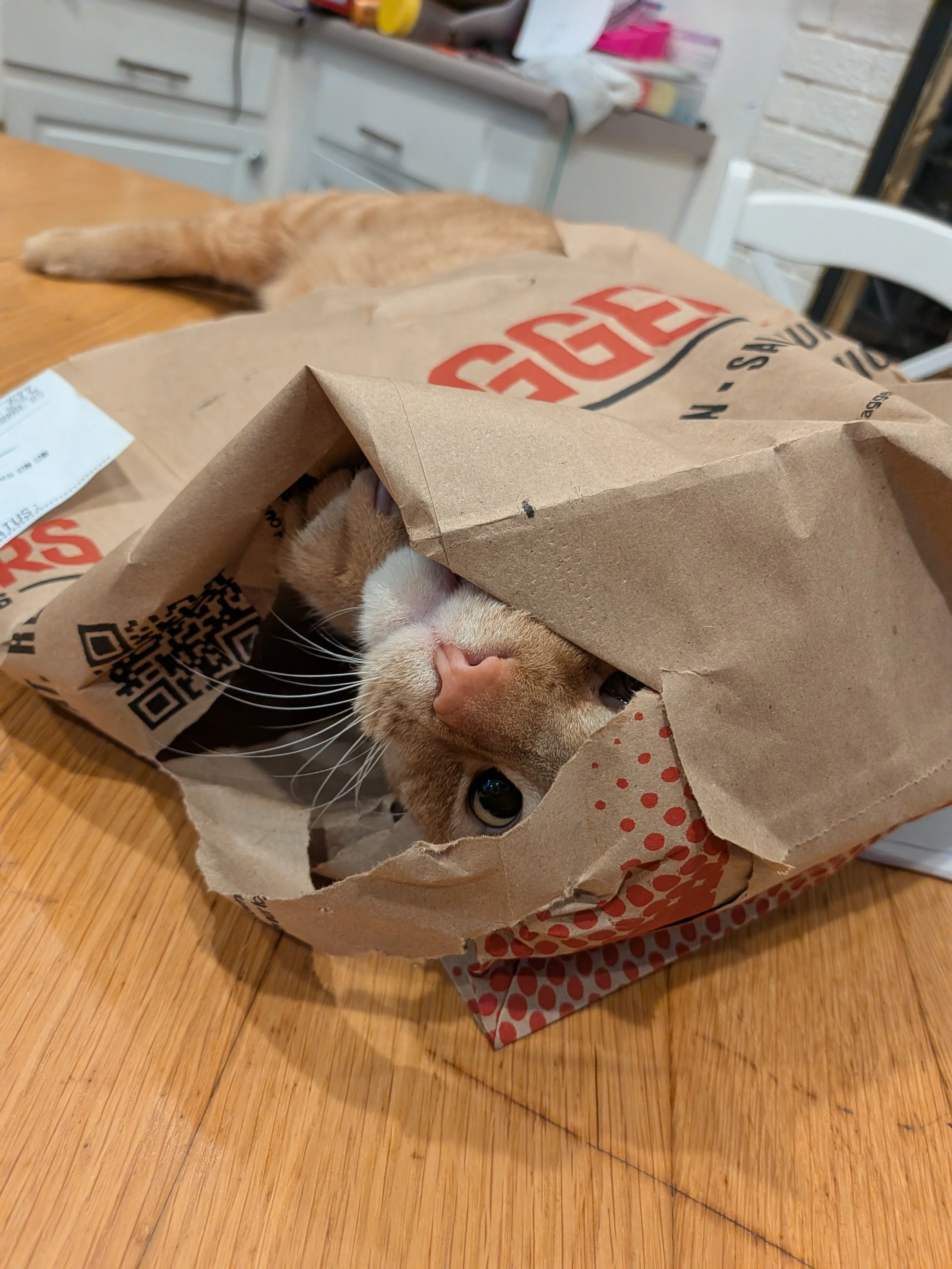
Bags: Any bag. Shopping bags, paper bags, plastic bags, the expensive reusable ones humans buy to feel virtuous. If it crinkles, Carl must sit in it. If it doesn't crinkle, well, he'll sit in it anyway. His ancestors cornered the bread market; he corners himself in grocery bags. It's practically the same thing.
Dog Food: While Sir Charles would have sooner eaten kibble than be seen interested in it, Carl has developed what he calls "an appreciation for alternative cuisines." When the family dog isn't looking, Carl sidles up to the dog bowl and helps himself to a few morsels. Is it beneath him? Absolutely. Does it taste like crunchy, artificial-chicken-flavored glory? Also absolutely.
The Eternal Treat Quest: If Sir Charles's life was defined by building a baking empire, Carl's is defined by the relentless pursuit of the Next Treat. He knows the sound of every treat bag in the house. The Temptations? A distinctive crinkle in the E-flat range. The Greenies? A deeper, more substantial rattle. His humans think they control treat distribution. How charmingly naive.
Carl has a particular technique: he sits near his human, makes intense eye contact, and emits a small, pathetic chirp—as if to say, "I am a poor, starving cat who has never been fed, despite my robust physique suggesting otherwise." It works 40% of the time, every time.
Epilogue: The Crumblesworth Legacy
On quiet evenings, when Carl is sprawled across the back of the couch (his favorite throne), one might wonder if he ever thinks about his illustrious ancestor. Does he ponder Sir Charles's rise from mill mouser to industrial titan? Does he consider the dynasty that rose so high and fell so far?
Probably not. Carl is currently thinking about whether the bag the groceries came in would be better for sitting in or pouncing on. Also, it's been at least forty-five minutes since his last treat, which is frankly unacceptable.
But perhaps that's the true Crumblesworth legacy—not the bakeries or the factories or the empire that crumbled to dust, but the absolute confidence that one deserves the finest things in life, whether that's artisanal sourdough or a stolen bite of kibble. Fortune may fade, but dignity remains.
Sir Charles built an empire. Carl conquered the couch. In their own ways, both were kings.
Or Sir Charles would be horrified by his descendant. Either way, Carl just knocked a pen off the table and would like his dinner now, please.
Contact us
Interested in working together? Fill out some info and we will be in touch shortly. We can’t wait to hear from you!